

Overview
In Talqui’s BotBuilder, blocks are also referred to as Neurons, and the connections between blocks are analogous to synapses between neurons. This naming convention reflects the interconnected nature of the flow-based architecture, where blocks connect and communicate like neural pathways. Neurons are the fundamental building blocks of chatbot flows. Each neuron represents a specific action, decision point, or processing step in the conversation. Just as biological neurons transmit signals through synapses to create complex neural networks, chatbot neurons pass information and control flow through connections to create sophisticated conversational experiences.What are Neurons?
Neurons in the BotBuilder are individual processing units that perform specific functions within a conversation flow. Each neuron can:- Send messages to users
- Receive and process user input
- Make API calls to external services
- Perform conditional logic to route conversations
- Store and retrieve data from conversation context
- Integrate with external systems through HTTP requests
🤔 Why are they called Neurons?
The term “Neuron” was chosen to reflect the parallel between biological neural networks and chatbot flow architecture:- Interconnected Structure: Just as biological neurons form networks through synapses, chatbot neurons form conversation flows through connections. Each connection represents a pathway that information and control can follow.
- Processing Units: Both biological neurons and chatbot neurons act as processing units. Biological neurons process electrical signals, while chatbot neurons process conversational data, user input, and system responses.
- Signal Transmission: Information flows through both systems similarly. In biological systems, signals travel from neuron to neuron through synapses. In chatbot flows, conversation state and data travel from neuron to neuron through connections.
Neuron Selector
The Flow Builder provides a neuron selector in the left sidebar of the editor, allowing developers to browse and add different types of neurons to their flows. This selector organizes neurons by category and provides access to both standard neurons provided by Talqui and custom neurons created by developers.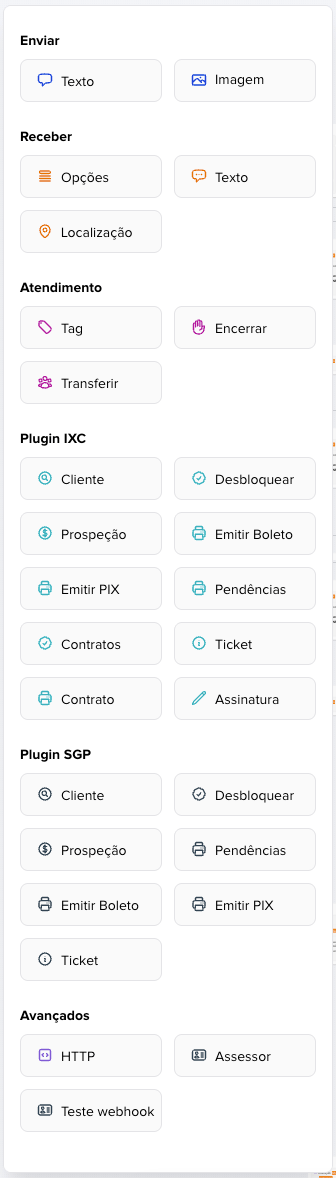
Neuron Selector
- Message neurons for sending and receiving messages
- Menu neurons for presenting options to users
- Conditional neurons for routing based on logic
- Integration neurons for API calls
- Custom neurons created through Generic Neuron registration
Neuron Types
Talqui’s BotBuilder provides several types of neurons, each designed for specific use cases:HTTP Neuron
The HTTP Neuron is an integration method for generic APIs where the primary concern is sending information to a third-party system rather than altering the conversational flow based on the API response. The conversational flow is not branched according to the response returned by the API, which is why this neuron has only two outputs: a success output and a failure output. When processing enters this neuron, if the system successfully makes the HTTP request to the destination and receives a 2xx status code response, it will proceed through the success output. However, if the HTTP request returns any status code outside the 2xx range, it will proceed through the failure output, which is identified as the error output. It is important to note that the HTTP Neuron also supports receiving variables that can be injected into the current conversation context, whether in the contact context or the session context, which are separate entities. For more detailed information about the HTTP Neuron, including configuration options, variable handling, and response patterns, refer to the HTTP Neuron documentation.Generic Neuron (Pre-registered Blocks)
The second integration method uses pre-registered blocks. In the BotBuilder’s left sidebar menu, developers have access to various conversation elements already pre-defined by Talqui. However, developers can extend functionality by creating additional blocks through block registration. Under the hood, these pre-registered blocks are also HTTP calls. However, this method provides the alternative of implementing branch-based responses. Developers can create blocks by calling Talqui’s endpoint and pre-registering the blocks they need. When pre-registering blocks, developers register the endpoint, the response pattern, the parameters required by the block, and various other configuration details, enabling blocks to have dynamic outputs. Pre-registered blocks can have as many outputs as necessary, allowing for complex routing logic based on API responses. For more information about creating and configuring pre-registered blocks with dynamic outputs, refer to the Generic Neuron documentation.Message Processing
Understand how neurons process messages in the flow.
Neuron HTTP
Learn how to use the HTTP neuron for API integrations.
Neuron Generic
Learn how to create custom neurons with dynamic outputs.